

Start Here
Most PHP developers need just one package:When You Need More Control
Instructor is built on a modular architecture. If you need to work at a lower level or integrate with specific frameworks, these packages are available separately.The Stack
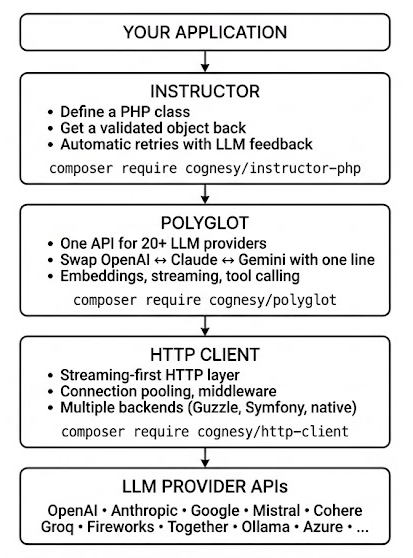
Package Details
Instructor
The main package. Start here. Structured data extraction powered by LLMs. Define a PHP class with typed properties, pass it to Instructor with some text, get a validated object back.- Type-safe outputs (your IDE understands the response)
- Automatic validation with Symfony Validator
- Self-correcting retries (LLM gets feedback on errors)
- Works with any provider through Polyglot
Polyglot
Use this when you need direct LLM access without structured extraction. A unified interface for LLM providers. Write code once, run it against any provider. Useful when you’re building chat interfaces, agents, or need raw completions.- Same code works with 20+ providers
- No vendor lock-in
- Streaming, embeddings, tool calling
- Test with cheap/fast models, deploy with powerful ones
HTTP Client
Use this when you need low-level HTTP control. The HTTP layer that powers Polyglot. Most developers never touch this directly, but it’s available if you need custom HTTP handling, middleware, or want to build your own LLM integrations.- Streaming-first design
- Middleware pipeline
- Multiple backends
- Single-request transport only
HTTP Pool
Use this when you need concurrent request execution.http-pool handles fan-out workloads. It uses the same request and response objects as http-client, but the execution model is separate and focused on batching.
- Concurrent request execution
- Typed request and response collections
- Separate from single-request transport
Laravel Integration
Use this if you’re building with Laravel. Adds Laravel-specific conveniences: service provider, facades, config publishing, and testing fakes.- Auto-discovery (just install and use)
- Laravel-style configuration
- Testing fakes for unit tests
- Integrates with Laravel’s logging
Symfony Integration
Use this if you’re building with Symfony. Adds a first-party bundle surface for config translation, framework-owned event delivery, telemetry, logging, Messenger handoff, and package-aligned testing seams.- one
instructorconfig root instead of scattered Symfony glue - package-owned event, delivery, telemetry, and logging wiring
- AgentCtrl and native-agent seams that work in HTTP, Messenger, and CLI contexts
- documented testing and migration path